
What should I know about my home's propane tank and heating system to ensure a safe, uninterrupted heat supply while I'm away?
What should I know about my home's propane tank and heating system to ensure a safe, uninterrupted heat supply while I'm away? Learn to prevent frozen pipes.
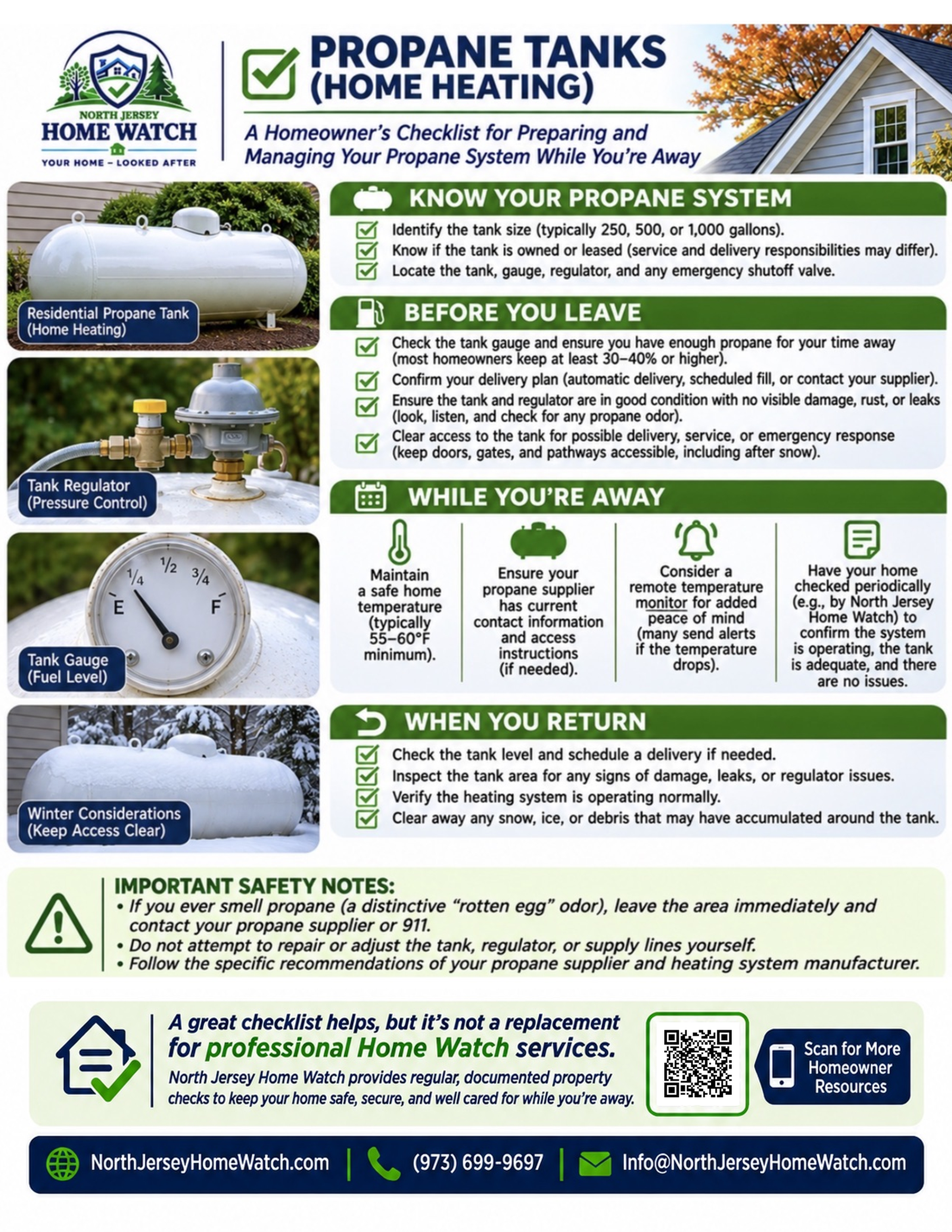
Winter in North New Jersey brings a unique set of challenges for homeowners who travel. As the temperatures drop, the reliability of your heating system becomes the primary line of defense against catastrophic property damage. If you are asking yourself, "What should I know about my home's propane tank and heating system to ensure a safe, uninterrupted heat supply while I'm away?", you are already ahead of most. The reality is that a single failed component or an empty fuel tank can lead to frozen pipes, flooding, and thousands of dollars in repairs within a matter of days.
We have seen it happen far too often. A homeowner leaves for a two-week trip, a cold snap hits, and the propane delivery that was supposed to happen gets delayed by a snowstorm. Without fuel, the furnace dies. The house temperature plummets, and the water inside the copper pipes expands until they burst. When we arrive for a scheduled check, we find a literal ice palace. Preventing this requires more than just luck; it requires a strategic understanding of your fuel supply and mechanical systems.
The Realities of Propane Supply Management
Propane is an efficient way to heat a home, but it is not a set-it-and-forget-it resource. Unlike natural gas, which is piped in via a utility line, propane is a finite resource sitting in a tank on your property. Understanding the capacity of your tank is the first step toward security. Most residential tanks in North New Jersey are either 500 or 1,000 gallons. However, for safety reasons related to pressure and expansion, these tanks are only filled to 80% capacity. This means a 500-gallon tank actually only holds 400 gallons of usable fuel.
To answer the question, "What should I know about my home's propane tank and heating system to ensure a safe, uninterrupted heat supply while I'm away?", you must first master your gauge. Propane gauges show a percentage, not gallons. If your gauge reads 20%, you are dangerously low. During a harsh cold front, a large home can easily consume 10 to 15 gallons of propane per day. If a delivery truck cannot reach you due to icy roads, that 20% buffer disappears quickly. We recommend never letting your tank drop below 30% before a planned departure.
Automated Monitoring vs Manual Checks
Many modern propane providers offer "automatic delivery" based on a degree-day calculation. This is a mathematical estimate of how much fuel you use based on outdoor temperatures. While helpful, it is not foolproof. It does not account for a drafty window left cracked or a thermostat malfunction that keeps the heat running at 72 degrees.
Digital tank monitors are the gold standard for absentee owners. These devices sit on the tank and send real-time levels to an app on your smartphone. When we provide professional home watch services, we often coordinate with homeowners who use these monitors to ensure the physical reading on the tank matches what the app is reporting. A stuck float gauge in a tank can give a false reading, leading you to believe you have fuel when you are actually running on fumes. Physical verification is the only way to be certain.
What Should I Know About My Home's Propane Tank and Heating System to Ensure a Safe, Uninterrupted Heat Supply While I'm Away?
Beyond the fuel level, you need to understand the mechanics of the heating system itself. Propane furnaces and boilers require electricity to operate. Even if your tank is full, a power surge or a tripped breaker can shut down your heat. In North New Jersey, winter storms often knock out power lines. If your home does not have a standby generator, your heating system will stop.
Furthermore, you must consider the intake and exhaust vents. High-efficiency furnaces typically vent through PVC pipes on the side of the house rather than a traditional chimney. During heavy snowfall or drifting winds, these vents can become blocked. If the furnace cannot "breathe," the integrated safety switches will shut the system down to prevent carbon monoxide buildup. If you are away, you won't know the system has tripped until the pipes have already frozen. Having someone physically clear snow away from these vents is a critical part of winter home maintenance.
The Vulnerability of Frozen Pipes
Why does the heat matter so much? It is all about the plumbing. Water is one of the few substances that expands when it freezes. This expansion exerts thousands of pounds of pressure per square inch, easily rupturing metal or plastic pipes. The most vulnerable areas are typically crawl spaces, attics, and exterior walls where insulation may be thin.
When we ask, "What should I know about my home's propane tank and heating system to ensure a safe, uninterrupted heat supply while I'm away?", we are really asking how to keep the interior ambient temperature above 55 degrees Fahrenheit. While you might be tempted to lower the thermostat to 45 degrees to save money on propane, this is risky. In a large house, the temperature in the furthest corners or inside the walls will be significantly lower than what the thermostat in the hallway reads. Maintaining a minimum of 55 to 58 degrees provides a necessary safety margin.
Steps to Take Before You Depart
Before you lock the door and head south for the winter, perform a comprehensive sweep of your heating infrastructure. Start by calling your propane provider. Confirm that your account is in good standing and that they have a credit card on file for automatic billing. Ask them when your last tank inspection was performed; regulators and valves can degrade over time, leading to slow leaks.
Next, change the air filters in your furnace. A clogged filter restricts airflow, forcing the blower motor to work harder and potentially causing the system to overheat and shut down. If you have a boiler system, check the water pressure gauge to ensure it is within the manufacturer’s recommended range.
It is also wise to open cabinet doors under sinks in kitchens and bathrooms. This allows the warm air from the room to circulate around the pipes. If you have a particularly problematic area, such as a laundry room over a garage, consider installing a low-temperature sensor. these devices can alert your phone or a central monitoring station if the house temperature drops below a specific threshold. However, an alert is only useful if you have someone local who can respond immediately.
The Role of Professional Oversight
Technology is a wonderful tool, but it is not a substitute for a physical presence. Smart thermostats can fail or lose Wi-Fi connection. Battery-powered sensors can die. A professional home watch service provides the human element that technology lacks. We don't just look at a screen; we walk the perimeter, check the vents, look at the propane gauge, and feel the air coming out of the vents.
In North New Jersey, weather conditions change rapidly. A mild Tuesday can turn into a blizzard by Thursday. Knowing that someone is scheduled to visit your property to verify that the propane levels are sufficient and the heating system is cycling properly provides peace of mind that no app can match. We act as your eyes and ears, identifying small issues—like a pilot light that has gone out or a leaking circulator pump—before they escalate into a total system failure.
If you are wondering, "What should I know about my home's propane tank and heating system to ensure a safe, uninterrupted heat supply while I'm away?", the most important answer is that you need a redundancy plan. You need a full tank, a maintained furnace, and a trusted professional to verify everything is working as intended.
Don't leave your home's safety to chance this winter. If you are planning to be away from your North Jersey residence, we can help you implement a robust winterization and monitoring strategy. Contact me today to schedule a consultation talk about your home and ensure it remains warm and protected all season long.
Have more questions? View our full FAQ page
Questions, answered.
How long will a 500-gallon propane tank last in the winter?
A 500-gallon tank typically holds 400 gallons of usable fuel. In a standard 2,500-square-foot North Jersey home, this may last 4-6 weeks during peak winter months, depending on your thermostat settings and the home's insulation. However, a severe cold snap can double fuel consumption, so frequent monitoring is essential.
What temperature should I set my thermostat to when I am away?
We recommend setting your thermostat no lower than 55°F (13°C). While it is tempting to save on fuel, lower settings increase the risk of pipes freezing inside exterior walls or in unheated areas like crawl spaces where the temperature is significantly lower than the thermostat's location.
Can my furnace stop working even if I have plenty of propane?
Yes. Common causes for furnace failure include power outages, tripped circuit breakers, clogged air filters, or snow blocking the exterior intake/exhaust vents. High-efficiency units are particularly sensitive to vent obstructions, which will trigger an automatic safety shutdown regardless of your fuel levels.