
What should I do if I discover a downed power line near my home, and how can I keep my family and property safe?
What should I do if I discover a downed power line near my home, and how can I keep my family and property safe? Follow these life-saving safety steps.
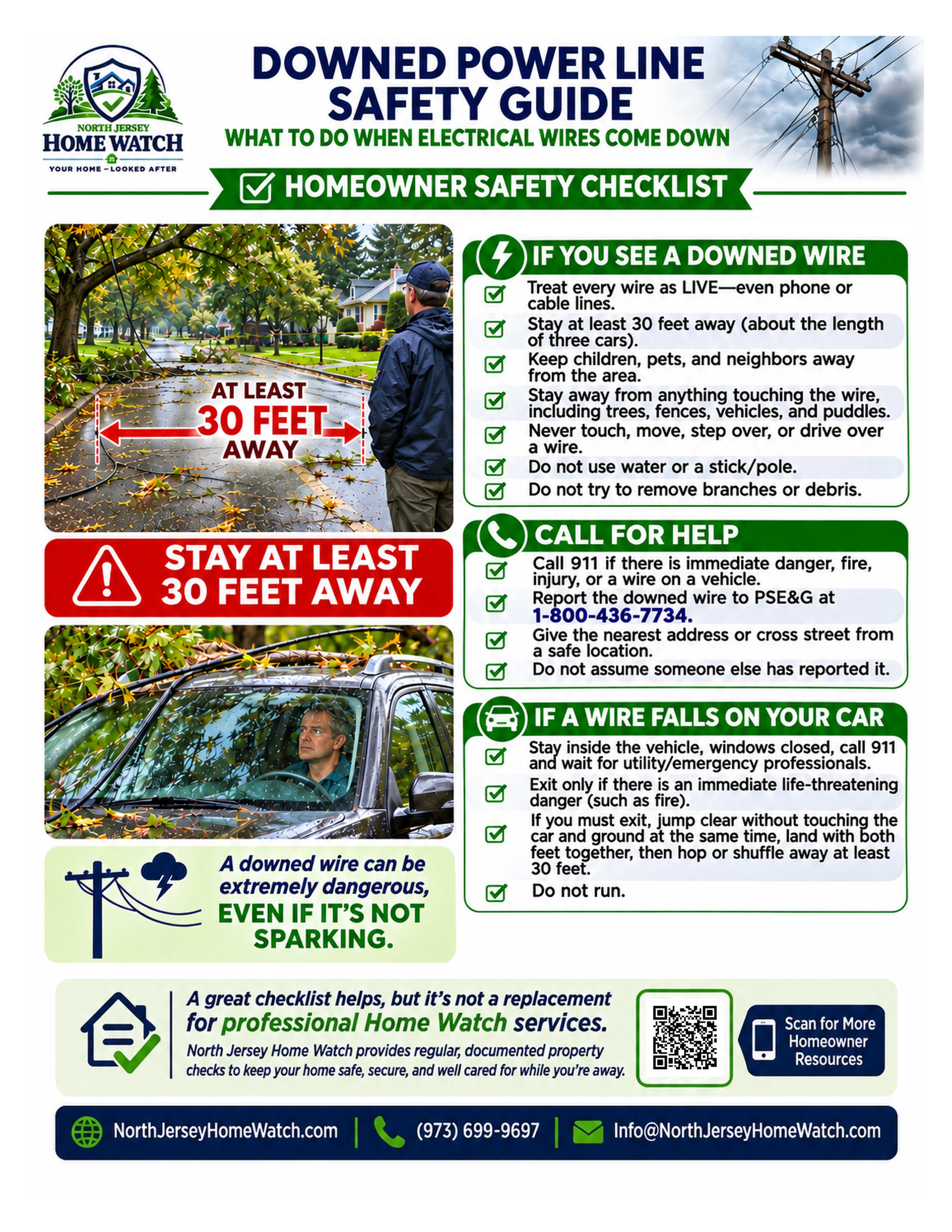
North Jersey is no stranger to volatile weather. Between the heavy snows of mid-winter and the sudden, violent thunderstorms of a humid July, our local power grid takes a beating. When the wind howls through the Passaic, Hudson, Mooris, Essex, Bergen County suburbs or the Highlands, trees often buckle, bringing utility lines down with them. This raises a critical question for every resident: What should I do if I discover a downed power line near my home, and how can I keep my family and property safe? In our line of work, we see the aftermath of these storms firsthand. We have walked properties where a single fallen oak has transformed a peaceful backyard into a high-voltage danger zone. Understanding the physics of electricity and the protocol for reporting these hazards is not just a matter of property maintenance; it is a matter of survival.
The Lethal Nature of Fallen Utility Lines
The most dangerous mistake a homeowner can make is assuming that a quiet wire is a dead wire. In the movies, downed power lines are often depicted as thrashing, sparking snakes that emit a loud buzzing sound. In reality, a line can be energized and lethal without showing any outward signs of activity. It does not need to smoke, spark, or hum to kill. If you see a wire on the ground, on a fence, or tangled in a tree, you must treat it as a live, high-voltage conductor. Electricity is constantly seeking a path to the ground, and your body is an excellent conductor.
What should I do if I discover a downed power line near my home, and how can I keep my family and property safe? The first step is acknowledging that the ground around the wire might be energized as well. When a high-voltage wire touches the earth, the electricity spreads out in concentric circles, similar to a stone dropped in a pond. The voltage is highest at the point of contact and decreases as you move away. However, if you walk normally, your legs can bridge two different voltage zones, causing electricity to flow through your body. This is known as step potential. To stay safe, you must maintain a significant distance—at least 30 feet, though 50 feet is safer—and never approach the area for any reason.
Immediate Actions and Reporting Protocols
If you spot a line down, do not call your electrician first. Your first call must be to 911, followed immediately by a call to your local utility provider, such as PSE&G or Jersey Central Power & Light (JCP&L). These entities have the equipment to remotely de-energize sections of the grid and the specialized crews to handle repairs safely. While waiting for help to arrive, your role is to act as a sentry. Do not let neighbors approach, and ensure that no one tries to drive over the wire. Even if the wire looks like a cable or telephone line, treat it as high-voltage power. Many telecommunications lines run directly beneath power lines, and if a power line falls, it can energize everything beneath it, including metal fences and guardrails.
For those who travel frequently or own seasonal properties in the region, the risk is compounded by the fact that you might not be home to see the damage occur. This is where professional home watch services become invaluable. We provide the eyes and ears on the ground when you are away, checking for storm damage and reporting hazardous conditions to the authorities before they can cause a fire or injury. Knowing that someone is checking the perimeter of your home after a North Jersey nor'easter provides a level of security that a smart camera simply cannot offer, especially if the power is out and your Wi-Fi is down.
What should I do if I discover a downed power line near my home, and how can I keep my family and property safe from a vehicle?
One of the most terrifying scenarios involves a power line falling onto your car while you are inside it. This often happens during storms or after a motor vehicle accident involving a utility pole. If this happens to you, the safest place to be is inside the vehicle. The rubber tires do not insulate the car from the electricity, but the metal frame of the vehicle acts as a Faraday cage, directing the current around the exterior rather than through the occupants. Stay put, call 911, and warn anyone who approaches to stay back.
The only exception to this rule is if the vehicle catches fire. If you must exit, you cannot step out normally. You must jump clear of the vehicle with both feet together, ensuring you do not touch the car and the ground at the same time. Once you land, you must shuffle your feet or hop away, keeping both feet in contact with each other or the ground at all times. Do not take large strides. By keeping your feet together, you minimize the risk of step potential, preventing electricity from using your body as a bridge between two different voltage levels on the ground.
Protecting Children and Pets in the Danger Zone
Children are naturally curious, and a downed wire might look like a harmless rope or a new backyard obstacle to them. It is vital to educate your family about the dangers of utility equipment long before a storm hits. Teach them that any wire on the ground is "hot" and off-limits. During the aftermath of a storm, keep pets on a short leash. A dog running toward a downed wire in high grass can be electrocuted instantly, and if you rush in to save them, you will likely become a victim as well.
What should I do if I discover a downed power line near my home, and how can I keep my family and property safe during a cleanup? After the wind dies down, the temptation to start clearing branches is high. However, if there are wires entangled in those branches, the wood can be conductive, especially if it is wet. Wait for the utility company to give the "all clear" before you begin any yard work. North Jersey's dense canopy means that many lines are hidden by foliage; always look up before you look down. If you see a branch hanging near a line, do not attempt to trim it yourself. Hire a licensed tree service that is certified to work near high-voltage lines.
Electrical Emergencies and Property Protection
Beyond the immediate physical danger, downed lines pose a significant fire risk. If a wire falls on a structure, it can cause an electrical fire that starts inside the walls, making it difficult to detect until it is too late. Homeowners should know where their main electrical panel is and how to shut off the main breaker, but only if it is safe to do so. Never enter a flooded basement to reach a breaker box, and never touch electrical equipment while standing in water.
When we ask ourselves, "What should I do if I discover a downed power line near my home, and how can I keep my family and property safe?", we must also consider the internal systems of the house. Power surges often accompany line failures. When the utility company restores power, the sudden influx of energy can fry sensitive electronics and appliances. Using high-quality surge protectors and considering a whole-house surge protection system can mitigate this risk. Furthermore, if a line has been ripped from the side of your house, the damage to the "weather head" or mast is the homeowner's responsibility to repair. You will need to hire a licensed electrician to fix the attachment point before the utility company will reconnect your service.
The Importance of Vigilance in North Jersey
Living in North Jersey means accepting that the infrastructure is older and the trees are tall. We live in a beautiful but geographically challenging area for power stability. Being proactive is your best defense. Keep your trees trimmed away from your service drop—the line that runs from the pole to your house. Watch for leaning poles or sagging wires after heavy rains, as soil saturation can cause poles to shift.
If you are planning to be away from your residence for a week or a season, don't leave your safety to chance. A downed wire that goes unreported for days can lead to devastating property damage or a localized disaster. We take pride in monitoring North Jersey homes, ensuring that hazards are identified and addressed immediately. Whether it is a fallen limb or a downed power line, our goal is to ensure you return to a home that is exactly as you left it: safe, secure, and powered.
What should I do if I discover a downed power line near my home, and how can I keep my family and property safe? The answer is simple: Stay back, call for help, and wait for the professionals. No amount of yard work or convenience is worth the risk of contact with high-voltage electricity. By following these protocols, you protect not only your own life but the lives of your neighbors and first responders.
Maintaining a home in our region requires constant attention to the environment around you. I am here to help you navigate those challenges, offering local expertise and a watchful eye when you can't be there yourself. If you are concerned about the vulnerability of your property during storm season, it may be time to schedule a consultation to discuss how I can help protect your investment.
Have more questions? View our full FAQ page
Questions, answered.
How far away should I stay from a downed power line?
You should maintain a distance of at least 30 feet from any downed power line, though 50 feet is recommended for maximum safety. Remember that the ground around the wire can be energized through step potential, so staying far back is essential to prevent electrocution.
What is the correct way to report a downed wire in North Jersey?
If you see a downed power line, immediately call 911 to alert emergency responders. Once you have notified the police or fire department, call your local utility company—usually PSE&G or JCP&L in our area—to report the specific location so they can de-energize the line.
Can I drive over a downed power line if it's in the road?
No, you should never drive over a downed power line. The wire could become tangled in your vehicle's axles or wheels, and the weight of the car could cause the line to snap or whip, potentially energizing the vehicle or nearby structures. Find an alternate route.