
What should I check on my home's heating and air conditioning system to keep it operating efficiently and prevent problems while I'm away?
Wondering what should I check on my home's heating and air conditioning system to keep it operating efficiently and prevent problems while I'm away? Learn more
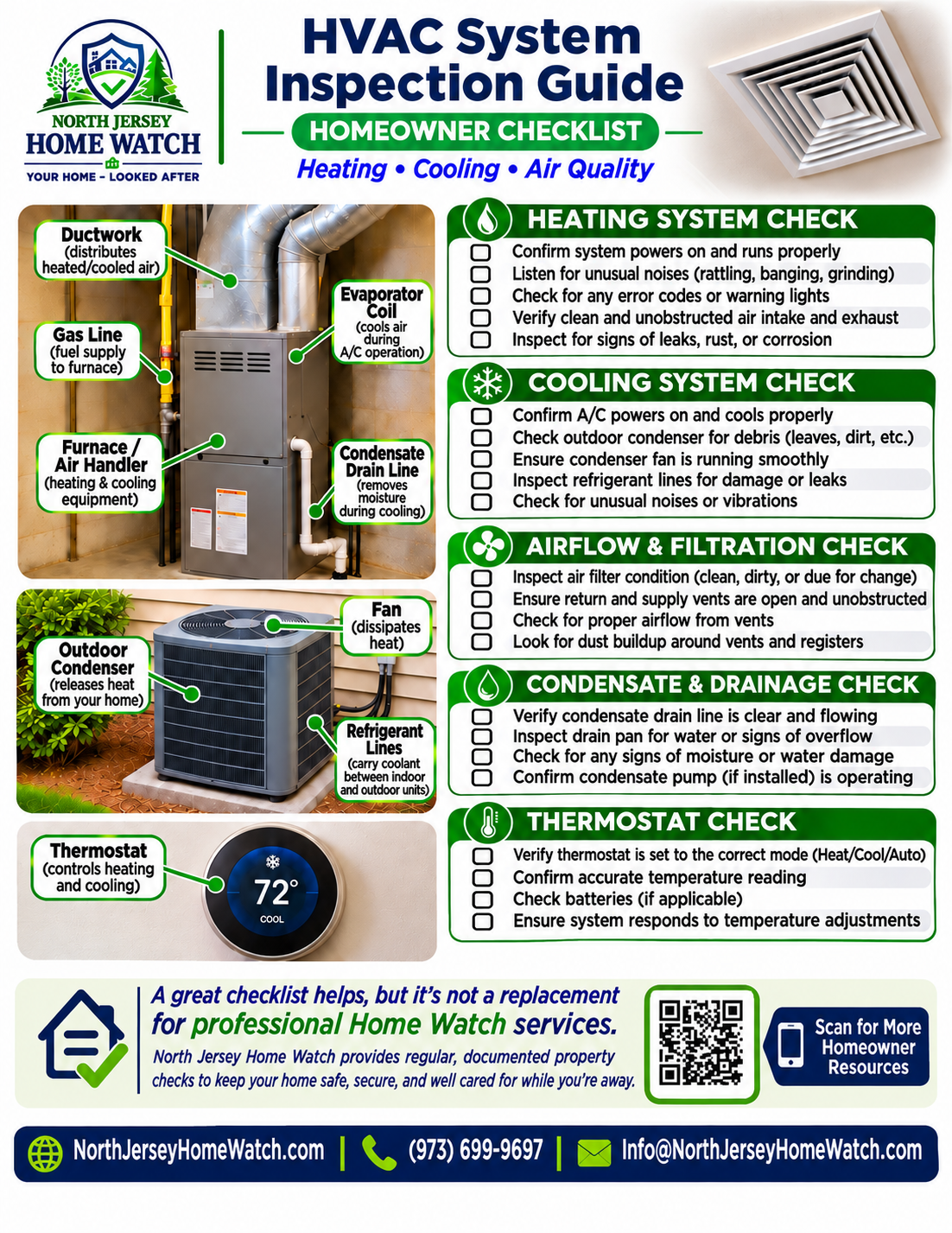
For many North New Jersey homeowners, the transition from a vibrant autumn to a biting winter—or the sudden arrival of a humid summer—marks a period of transition and often, travel. Whether you are heading south for the winter or escaping for a few weeks of summer vacation, your home remains behind, silently working to maintain its equilibrium. Central to that equilibrium is your HVAC system. When clients ask me, "What should I check on my home's heating and air conditioning system to keep it operating efficiently and prevent problems while I'm away?", they are asking the most critical question for home preservation. An HVAC failure in our region isn't just an inconvenience; in January, it can lead to frozen pipes and catastrophic water damage, while in July, it can invite mold growth that takes months to remediate.
At North Jersey Home Watch, I see the consequences of neglected systems firsthand. I have walked into properties where a simple $20 filter could have prevented a $5,000 repair bill. Efficiency isn't just about the utility bill; it is about reliability. A system that is struggling to breathe or one that is leaking refrigerant is a system on the verge of a shutdown. By taking a proactive approach to your mechanical systems before you lock the door, you ensure that your return to North New Jersey is met with a comfortable home rather than a disaster zone.
The Foundations of Airflow and Filtration
The lungs of your home are its vents and filters. If your HVAC system cannot breathe, it cannot function. One of the primary answers to the question, "What should I check on my home's heating and air conditioning system to keep it operating efficiently and prevent problems while I'm away?" is your air filter. A clogged filter forces the blower motor to work harder, increasing wear and tear and potentially leading to a total system freeze-up or overheating. Before you leave, replace your standard pleated filter with a fresh one. Do not opt for the highest possible MERV rating if your system isn't designed for it, as overly restrictive filters can be just as damaging as dirty ones.
Beyond the filter, you must inspect the registers and return vents throughout the house. It is a common mistake to close off vents in unused rooms to "save energy." In reality, modern HVAC systems are balanced for the specific square footage of your home. Closing vents creates backpressure that can damage the heat exchanger or cause the cooling coils to ice over. Ensure all interior doors are left slightly ajar to allow for proper air circulation, and check that no furniture or heavy drapes have shifted to block the return air grilles. This simple walk-through ensures the system operates at its designed efficiency while you are gone.
Identifying Early Warning Signs and Unusual Noises
Your HVAC system often tries to tell you it is failing before it actually stops. If you are preparing for an extended absence, spend some time listening to the unit while it is running. Do you hear a high-pitched squeal? That could be a belt slipping or a bearing failing in the motor. Do you hear a loud rattling or banging? This might indicate a loose component or a failing compressor. When you consider what should I check on my home's heating and air conditioning system to keep it operating efficiently and prevent problems while I'm away?, sound is one of your most reliable diagnostic tools.
Look for error codes on your thermostat or the furnace control board. Many modern systems have a small window where an LED light flashes in specific sequences to indicate issues like ignition failure or limit switch trips. If you see a code, do not ignore it. It is far cheaper to call a technician while you are still in town than to deal with an emergency repair remotely. We also recommend checking for any visible leaks around the indoor evaporator coil and the outdoor condenser unit. Pooling water can indicate a clogged condensate drain line, which is a frequent cause of system shutdowns during North Jersey’s humid summers.
Thermostat Settings and Smart Monitoring
Setting your thermostat correctly is a delicate balance between saving money and protecting your home's infrastructure. In the winter, never set your heat lower than 55 degrees Fahrenheit. While this might seem high, it provides a necessary buffer against extreme cold snaps that can penetrate wall cavities where plumbing resides. In the summer, keeping the air conditioning set to roughly 78 degrees helps manage indoor humidity, preventing the "musty" smell and potential mold growth common in North New Jersey homes during August.
Investing in a smart thermostat is one of the best ways to address the concern of what should I check on my home's heating and air conditioning system to keep it operating efficiently and prevent problems while I'm away? These devices allow you to monitor the temperature and humidity of your home from your smartphone. More importantly, they can send you alerts if the temperature drops below or rises above a certain threshold. However, technology is not foolproof. A Wi-Fi outage or a dead battery in the thermostat can leave you blind, which is why professional home watch services are a vital backup. We provide the physical presence that technology lacks, verifying that the air coming out of the vents is actually the correct temperature regardless of what the app says.
Outdoor Unit Maintenance and Security
The outdoor condenser unit is often forgotten until it fails. Before leaving, clear away any debris, such as fallen leaves, overgrown grass, or stray branches that have accumulated around the unit. The condenser needs at least two feet of clear space around it to dissipate heat effectively. If the fins are clogged with cottonwood seeds or dirt, the system will run longer and hotter, significantly shortening its lifespan. Use a garden hose (not a pressure washer) to gently rinse the coils if they appear dirty.
In North New Jersey, we also have to contend with local wildlife. Mice and squirrels love the warmth of a recently shut-off transformer or the insulation on refrigerant lines. Inspect the "whip" or the electrical conduit leading to the unit for any signs of chewing. Additionally, ensure the refrigerant line insulation is intact. Exposed copper lines lose efficiency and can lead to condensation dripping in places it shouldn't. By securing the exterior, you are closing the loop on your HVAC protection strategy.
The Role of Professional Inspections
While a homeowner can perform many basic checks, there are components that only a professional can evaluate. Before a long trip, we always suggest having a licensed technician perform a seasonal tune-up. They will check refrigerant levels, measure amperage draw on the motors, and inspect the heat exchanger for dangerous cracks. When you ask yourself, "What should I check on my home's heating and air conditioning system to keep it operating efficiently and prevent problems while I'm away?", the answer should include a professional verification of the system's internal health.
A technician can also clear your condensate drain line with compressed air or a vacuum. A clogged drain line is one of the most common reasons an AC unit shuts down in the middle of a heatwave. If the secondary drain pan fills with water, a float switch will kill power to the unit to prevent an overflow. While this saves your floors from water damage, it leaves your home without climate control, leading to skyrocketing humidity. A quick professional cleaning prevents this entire chain of events.
Creating a Redundancy Plan
No matter how much maintenance you perform, mechanical systems can still fail. The key to true peace of mind is having a redundancy plan. This includes having a trusted local contact who has a key to your home and knows how to contact your preferred HVAC contractor. At North Jersey Home Watch, I act as that essential link. I don't just check the thermostat; I check the actual temperature of the air, inspect the basement for leaks, and ensure the outdoor unit is clear of snow or debris after a storm.
If I discover a problem, I act immediately based on your pre-authorized instructions. This level of oversight is the final step in answering what should I check on my home's heating and air conditioning system to keep it operating efficiently and prevent problems while I'm away? It isn't just about the machine; it's about the system of care surrounding your home. Whether it's a tripped breaker or a failed blower motor, catching the issue within days—rather than weeks—makes the difference between a minor repair and a total home renovation.
Final Walk-Through Checklist
Before you head out, do one final sweep. Check that the emergency shut-off switches (which often look like light switches near your furnace) are in the 'ON' position. Ensure the gas valve is open if you are leaving the heat on. Verify that your smart home hub is connected to the internet and that you have fresh batteries in any remote sensors. These small details are often the ones that cause the most stress when forgotten.
By following these steps, you are doing more than just maintaining a machine; you are protecting your largest investment. North New Jersey weather is unpredictable, but your home's response to it shouldn't be. Taking the time to perform these checks ensures that your time away is spent relaxing, not worrying about what is happening back at the house.
If you want to ensure your property is managed by professionals who know exactly what to look for, I am here to help. You can schedule a consultation with me today to discuss a customized home watch plan that covers your HVAC system and everything in between.
Have more questions? View our full FAQ page
Questions, answered.
What temperature should I leave my North Jersey home at during the winter?
We recommend setting your thermostat no lower than 55 degrees Fahrenheit. While it may be tempting to go lower to save on heating costs, 55 degrees provides a necessary safety margin to prevent pipes located in exterior walls from freezing during the extreme cold snaps common in North New Jersey.
How often should I change my HVAC filter if the house is empty?
Even in an empty house, you should start your trip with a fresh filter. While it won't get dirty as quickly without occupants kicking up dust, a clean filter ensures maximum airflow and prevents the system from straining. If you are away for more than three months, have your home watch provider check the filter status.
Can I just turn my AC off completely during the summer?
We strongly advise against turning your AC off entirely in North New Jersey. The humidity in our region can quickly lead to mold growth and wood warping inside a closed home. Setting the AC to 78 or 80 degrees allows the system to dehumidify the air, protecting your home's interior structures and belongings.