How Can I Secure My Home's Doors and Manage Access Safely While I'm Away?
How can I secure my home's doors and manage access safely while I'm away? Discover the best smart locks and security strategies for North Jersey homeowners.
For many homeowners in North Jersey, the transition from a weekend getaway to a seasonal relocation brings a familiar sense of anxiety. We often find ourselves double-checking the locks one last time before pulling out of the driveway, wondering if we left a spare key in a spot that is just a little too obvious. When clients ask us, "How can I secure my home's doors and manage access safely while I'm away?", they are looking for more than just a sturdy bolt. They are looking for a system that balances impenetrable security with the flexibility to let in the people who need to be there. In an era where packages are delivered daily and service contractors require entry for maintenance, the traditional physical key is becoming a liability rather than an asset.
At North Jersey Home Watch, I have seen every type of entry system imaginable. I have navigated the complexities of high-end estates in Alpine and the charming multi-generational homes in Montclair. Protecting your property starts at the perimeter, and in this guide, we will break down the essential components of modern door security and access management to ensure your peace of mind while you are miles away from the Garden State.
Choosing the Right Hardware for Your Entryway
The first step in answering the question, "How can I secure my home's doors and manage access safely while I'm away?" is understanding the hardware options currently available. Security is not a one-size-fits-all solution, and the right choice often depends on your specific lifestyle and how frequently you expect visitors.
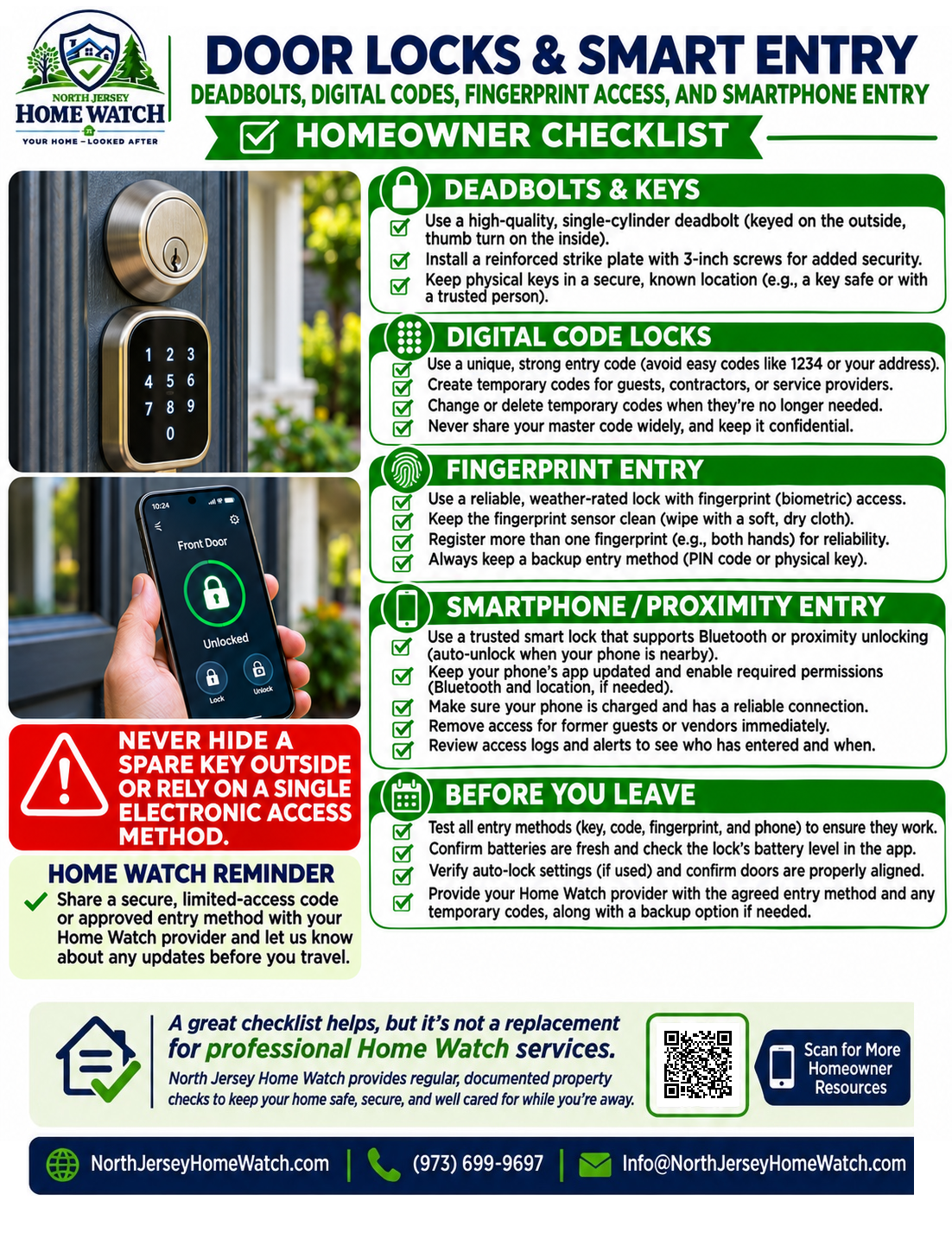
Traditional deadbolts remain the gold standard for physical resistance. A Grade 1 deadbolt provides the highest level of residential security against forced entry. However, the limitation of a traditional lock is the physical key itself. Keys can be lost, duplicated without your knowledge, or stolen. For homeowners who are away for long periods, the inability to track who has a key creates a significant security gap.
Digital keypads offer a significant upgrade in terms of convenience. By replacing the keyhole with a numbered interface, you eliminate the risk of lock picking and the need for physical keys. These are excellent for those who want a simple, standalone solution that doesn't necessarily require a smartphone to operate. However, basic keypads often lack the remote management features that seasonal residents truly need.
Fingerprint locks, or biometric entries, provide a high level of personalized security. It is nearly impossible to spoof a high-quality biometric scanner. While these are incredibly secure for the primary residents, they can be cumbersome if you need to grant entry to a plumber or a delivery driver who is not in your system. We generally recommend these as secondary layers of security rather than the primary method for managed access.
Smartphone-controlled entry systems are the modern standard for North Jersey homeowners. These locks connect to your home Wi-Fi or a dedicated hub, allowing you to lock and unlock your door from anywhere in the world. When you are sitting on a beach or in a winter home, the ability to check the status of your front door on an app is invaluable. These systems also integrate with cameras, providing a visual confirmation of who is standing on your porch before you grant them entry.
Managing Access Without Compromising Security
Once you have selected your hardware, the next challenge is managing the flow of people. Your home still needs maintenance while you are away. How can I secure my home's doors and manage access safely while I'm away? The answer lies in the strategic use of temporary access credentials. One of the greatest risks to a vacant home is the "master key" problem—giving one person a key that grants them permanent, unmonitored access.
Smart locks allow you to create unique, time-bound codes for different individuals. For example, if your landscaping team needs to access the garage or a side door every Tuesday between 10:00 AM and 12:00 PM, you can generate a code that only works during those specific hours. Once the window closes, the code becomes invalid. This level of granularity ensures that a contractor cannot return to your property unannounced in the middle of the night.
I also recommend assigning individual codes to every person who enters the home. Instead of a general "service" code, give your housekeeper one code and your professional home watch services provider another. This creates an audit trail. Most smart lock applications will send a push notification to your phone every time a specific code is used. You will know exactly when the house was opened and when it was locked back up. This transparency discourages unauthorized behavior and gives you a clear record of property maintenance.
For those who prefer not to use codes, some systems offer "e-keys" or digital invites. The visitor downloads a specific app, and their phone acts as the key via Bluetooth. While secure, this can be frustrating for older contractors or one-time visitors who do not want to install extra software. In our experience, a simple, unique numeric code remains the most reliable method for managed access in North Jersey.
Preventing Common Security Vulnerabilities
Even with the most expensive smart lock on the market, your security is only as strong as your habits. I frequently encounter homeowners who invest in high-tech systems but fall back on old, dangerous routines. The most common mistake is the "hidden" spare key. Whether it is under the fake rock, taped inside the mailbox, or perched on the door frame, professional intruders know exactly where to look. Hiding a key is essentially leaving your front door unlocked; it provides zero resistance and leaves no trace of entry for insurance purposes.
Another vulnerability is the "permanent guest" code. It is tempting to give a neighbor or a family member a code that never expires. However, if that person’s phone is compromised or if they accidentally share the code, your home is at risk. We advise our clients to set expiration dates on all codes, even for those they trust. Refreshing your access list every few months is a simple way to maintain a tight security perimeter.
Visible security cues also play a massive role in North Jersey. A smart lock that looks robust can act as a deterrent, but it should be paired with other common-sense measures. Ensure your entryway is well-lit with motion-activated lighting. If an intruder is standing at your door trying to guess a code or manipulate a lock, being bathed in a bright LED floodlight usually ends the attempt quickly. Furthermore, ensure that your smart lock’s "auto-lock" feature is enabled. This ensures that even if a guest forgets to turn the deadbolt behind them, the system will secure itself after a set period, typically 30 to 60 seconds.
The Role of Professional Oversight
Technology is a powerful tool, but it is not a complete replacement for human eyes. You might wonder, "How can I secure my home's doors and manage access safely while I'm away if the Wi-Fi goes out?" This is a valid concern. North Jersey is prone to storms that can knock out power or internet connectivity, potentially leaving your smart locks in an offline state. While most smart locks have a physical key backup or an external battery jump-start, you won't be able to manage them remotely if the gateway is down.
This is where a home watch professional becomes essential. I act as your local boots on the ground. If your app shows that a door was left ajar or if you lose connectivity to your security hub, I can physically visit the property to ensure everything is locked and the perimeter is secure. I can also be the one to meet a contractor who doesn't have a code, ensuring they are supervised while inside your home and that the door is properly deadbolted when they leave.
Securing a home in areas like Bergen, Passaic, Morris, or Essex County requires a proactive approach. By combining high-quality smart hardware, disciplined access management, and the elimination of "hidden keys," you significantly reduce your risk profile. You no longer have to wonder who has a copy of your house key or if the back door was left unlocked after the HVAC service call. You have the data, the control, and the peace of mind to enjoy your time away.
Your home is likely your most significant investment. Taking the time to modernize your entry points and implement a strict access policy is one of the most effective ways to protect that investment. Don't wait until a security breach occurs to rethink your strategy. Start by auditing your current locks and identifying who currently has access to your property.
If you are ready to enhance your property's protection and want a partner to help monitor your North Jersey estate, I am here to help. I provide the consistent, professional oversight necessary to ensure your smart systems are functioning and your home remains exactly as you left it. To learn more about how I can support your security goals, schedule a consultation with me today.
Have more questions? View our full FAQ page
Questions, answered.
What happens to my smart lock if the power goes out?
Most high-quality smart locks operate on battery power, meaning the locking mechanism itself will continue to function even during a North Jersey power outage. However, you may lose remote connectivity if your Wi-Fi router is down. We recommend choosing a lock with a physical key override or an external battery contact point to ensure you are never locked out.
Is it safe to give my contractor a temporary door code?
Yes, provided you use a unique code and set it to expire. Using time-bound codes allows you to grant access only during scheduled work hours. By assigning a specific code to the contractor, you create an audit trail in your lock's history, allowing you to see exactly when they entered and exited your property while you were away.
Can smart locks be hacked by intruders?
While no system is 100% foolproof, reputable smart locks use advanced encryption similar to online banking. It is far more common for an intruder to break a window or find a hidden spare key than to digitally hack a lock. To maximize security, use strong passwords for your accounts, enable two-factor authentication, and keep your lock's firmware updated.