
Thermostat Settings for North New Jersey Homeowners Leaving for the Season
Wondering how should I set my thermostat when leaving my home for an extended period? Learn how to protect your North Jersey property from freezes and humidity.
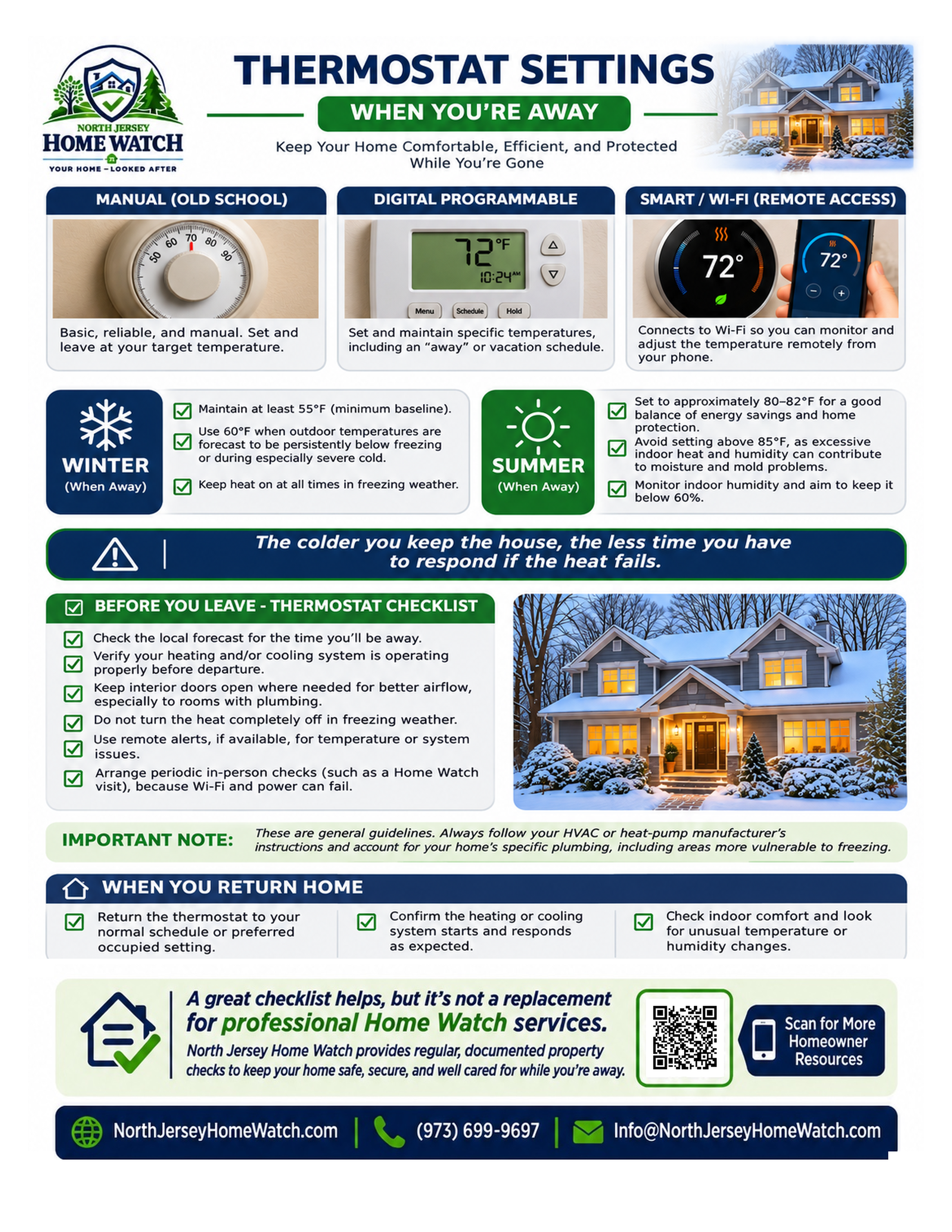
When you lock the door to your North New Jersey residence for a long getaway or a seasonal move to warmer climates, your HVAC system becomes your home’s primary defense against the elements. I often hear the same question from our clients: How should I set my thermostat when leaving my home for an extended period? It is a delicate balance. You want to avoid paying a fortune to heat or cool an empty house, but you cannot simply turn the system off. In our region, where winters are harsh and summers are notoriously humid, an improperly set thermostat can lead to burst pipes, warped flooring, or a blooming mold infestation.
Setting the temperature too low in the winter to save a few dollars on the gas bill is one of the most common mistakes I see. Conversely, shuting off the air conditioning during a humid July can turn your interior into a literal greenhouse. As a professional home watch company, I have seen the aftermath of these choices. The goal is to find the “sweet spot” that protects your investment while minimizing energy waste. This guide breaks down the specific settings required for both the heating and cooling seasons, along with the technical nuances that ensure your system keeps running until you return.
Winter Settings to Prevent Frozen Pipes
In North Jersey, the threat of a deep freeze is a constant reality from December through March. Many homeowners assume that as long as the temperature is above 32 degrees Fahrenheit, they are safe. This is a dangerous misconception. External walls and cabinets housing plumbing fixtures are often several degrees colder than the air near your thermostat. If you are asking, how should I set my thermostat when leaving my home for an extended period during the winter, our recommendation is a minimum of 55 to 58 degrees Fahrenheit.
Setting the dial to 55 degrees provides a necessary buffer. This ensures that even if a cold snap hits and your furnace struggles to keep up, the internal temperature of the wall cavities where your pipes reside stays above the freezing point. If your home is older or has known insulation issues in the crawlspace, we suggest bumping that up to 60 degrees. It is far cheaper to pay for a slightly higher heating bill than to remediate the water damage from a burst copper pipe in the ceiling.
Beyond the raw temperature, you must consider the fan setting. While it is tempting to leave the fan on “Auto” to save energy, some larger homes benefit from running the fan periodically to circulate air and prevent cold pockets. However, for most modern, well-insulated homes, the “Auto” setting combined with a 55-degree heat setpoint is sufficient. Ensure your thermostat is set to “Heat” and not “Auto-Changeover” to prevent the system from accidentally switching to cooling if the sun hits the sensor during a particularly bright winter day.
Summer Humidity Control and Cooling Strategies
When the New Jersey humidity rolls in during the summer months, the thermostat's role shifts from preventing freezes to managing moisture. If you leave your AC off entirely, the relative humidity inside your home will quickly climb above 60 percent. This creates the perfect environment for mold growth on drywall, upholstery, and stored clothing. When considering how should I set my thermostat when leaving my home for an extended period in the summer, we recommend a setting between 78 and 80 degrees Fahrenheit.
At 78 degrees, the air conditioner will cycle often enough to pull moisture out of the air. This process of dehumidification is just as important as the actual cooling. If you have a dedicated whole-home dehumidifier, you can afford to set the AC slightly higher, perhaps to 82 degrees, but for most standard systems, 78 is the limit for safety. High heat can also damage sensitive electronics and cause certain wood finishes or musical instruments to swell and crack. Keeping the air moving and the humidity low is essential for preserving the integrity of your interior finishes.
The Role of Smart Thermostats in Home Monitoring
Technology has changed the way we manage vacant or unoccupied properties. Devices like Nest, Ecobee, and Honeywell Home allow us to monitor your home’s status in real-time. If you find yourself wondering how should I set my thermostat when leaving my home for an extended period, a smart thermostat gives you the flexibility to adjust settings from your smartphone thousands of miles away. More importantly, these devices can send alerts. If the temperature drops below 45 degrees or the humidity spikes above 65 percent, you (and we) can be notified immediately.
However, smart thermostats are not infallible. They require a stable Wi-Fi connection and, in some cases, a steady power supply (the C-wire). We have seen instances where a power flicker causes a smart thermostat to lose its connection or revert to a default “Eco” mode that is too aggressive for the local climate. This is why automated systems are a supplement to, not a replacement for, physical inspections. Combining smart technology with our professional home watch services ensures that if the technology fails, a human eye is there to catch the problem before it escalates.
HVAC Maintenance Before Your Departure
Your thermostat is only as good as the machine it controls. Before you leave for an extended period, you must ensure the HVAC system is in peak condition. The most frequent cause of system failure during a homeowner’s absence is a dirty air filter. A clogged filter restricts airflow, which can cause the evaporator coils to freeze in the summer or the furnace to overheat and shut down in the winter. Always install a fresh, high-quality pleated filter the day you leave.
Additionally, check the batteries in your thermostat. Many older digital models rely on AA or AAA batteries to maintain their settings and communicate with the furnace. If those batteries die while you are gone, the system may default to an “off” state. Even if your thermostat is hardwired, a battery backup is common and should be replaced annually. We also recommend clearing any debris from around the outdoor condenser unit. North Jersey storms can blow leaves and branches against the unit, obstructing the airflow it needs to dump heat effectively during the summer.
How Should I Set My Thermostat When Leaving My Home For An Extended Period During Shoulder Seasons?
Fall and Spring in the Northeast are unpredictable. You might have a 70-degree afternoon followed by a 25-degree night. This is the only time we suggest considering the "Auto" mode on your thermostat, which switches between heating and cooling to maintain a specific range. However, this mode can be energy-intensive if the range is too narrow. A safe range for these months would be a heat setpoint of 55 and a cool setpoint of 82. This creates a "dead band" where the system does nothing unless the house hits an extreme, protecting you from both the last frost of April and the first heatwave of May.
Avoiding the Off Position
It is worth repeating: Never turn your HVAC system completely off. Some homeowners think they are being environmentally conscious by shutting everything down. In North Jersey, this is an invitation for disaster. Without active climate control, a home becomes a stagnant box. Moisture builds up, odors linger, and the structural materials of the house are subjected to rapid expansion and contraction. The cost of running your system at a minimal level is a small insurance premium to pay for the safety of your property.
Another critical step is to ensure that all interior doors are left open. This allows for even airflow throughout the house. If you close a bedroom door, that room may become significantly colder or more humid than the hallway where the thermostat is located. By keeping the interior doors ajar, you help the HVAC system maintain a consistent environment across every square foot of the home. This is particularly important for bathrooms and kitchens where water pipes are prevalent.
Coordinating With Your Home Watch Professional
Ultimately, the best settings depend on the unique layout and insulation of your specific property. When I perform my regular checks, I monitor the ambient temperature and humidity in multiple zones of your house, not just what the thermostat says. I can adjust your settings based on the immediate weather forecast, saving you money during a mild stretch and protecting you during a polar vortex. If you are preparing for a long trip and are still unsure, I can help you schedule a consultation to walk through your home and establish a custom departure checklist that includes your HVAC, water main, and security protocols.
Have more questions? View our full FAQ page
Questions, answered.
Can I just turn off my heat in the winter if I drain my pipes?
Even if you drain your supply lines, we do not recommend turning off the heat. Residual water in traps, toilets, and appliances like dishwashers can still freeze and crack. Furthermore, extreme cold can cause drywall to crack and wood flooring to contract excessively. Maintaining a minimum of 55 degrees protects the entire structure, not just the plumbing.
What is the ideal humidity level for a vacant home in New Jersey?
You should aim to keep your indoor relative humidity between 45% and 55%. Once humidity levels consistently exceed 60%, the risk of mold growth increases significantly. In North Jersey summers, setting your air conditioner to 78 degrees is usually sufficient to manage this, though some homes may require a standalone dehumidifier in the basement.
Should I use the 'Hold' or 'Program' setting on my thermostat?
When leaving for an extended period, use the 'Permanent Hold' setting. Programmed schedules are designed for daily occupancy and can cause unnecessary cycling of the system. A permanent hold ensures the temperature remains constant regardless of the time of day, which is more efficient and reliable for an empty house.