
How Does My Home’s Hot Water Boiler Work, What Should the Normal Readings Be, and How Do I Know If Something Is Wrong?
Learn how does my home’s hot water boiler work, what should the normal readings be, and how do I know if something is wrong to avoid costly winter repairs.
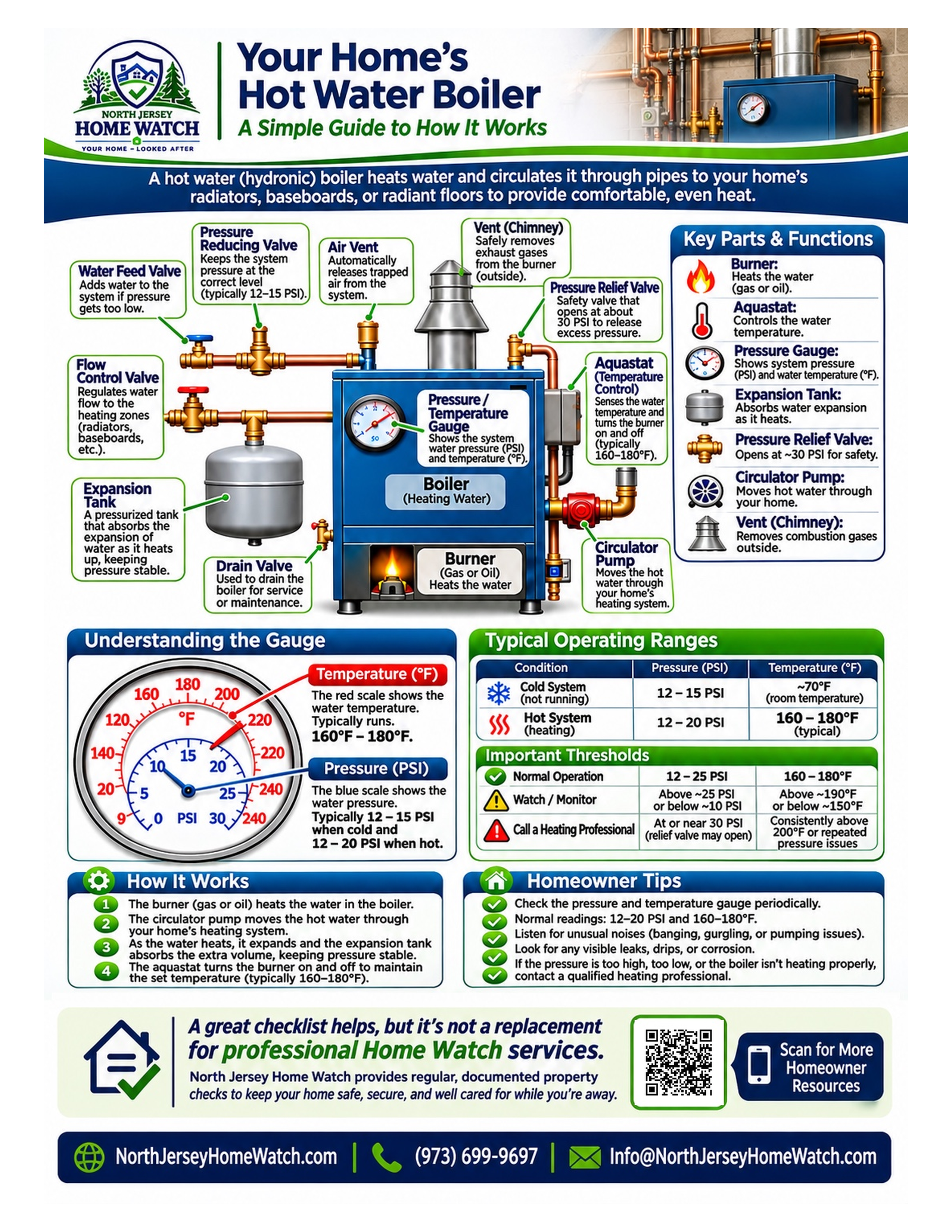
Winter in North New Jersey is more than just a seasonal shift; it is a rigorous stress test for your property. For many of our clients who head south for the winter or maintain secondary residences in the Highlands, the heating system is the most critical line of defense against catastrophic property damage. When the temperature drops below freezing in Morris or Sussex County, a failed boiler leads to burst pipes, ruined flooring, and massive remediation costs. To protect your investment, you need to understand the fundamentals of your heating plant. You might be asking: How Does My Home’s Hot Water Boiler Work, What Should the Normal Readings Be, and How Do I Know If Something Is Wrong?
Understanding the mechanics of your heating system is not just for technicians. It is essential knowledge for any homeowner who wants to maintain a safe, efficient residence. While a boiler might look like a confusing tangle of copper pipes and electrical boxes, its operation follows a very logical path. By the end of this guide, you will know exactly what to look for when you walk into your mechanical room, allowing you to catch small issues before they become five-figure emergencies.
The Fundamentals of Hydronic Heating
Most traditional homes in our region utilize hydronic heating. Unlike a furnace, which blows hot air through ducts, a boiler heats water and circulates it through a closed loop of pipes to radiators or baseboard units. It is essentially a large kettle controlled by a thermostat. When the air temperature in your living room drops, the thermostat sends an electrical signal to the boiler's control center, often called the aquastat. This triggers the burner—whether fueled by natural gas, oil, or propane—to ignite.
Inside the boiler, the heat from the flame is transferred to the water through a component called the heat exchanger. Once the water reaches the target temperature, a circulator pump pushes it through the house. As the water travels through your radiators, it releases its heat into the rooms, cools down, and returns to the boiler to be reheated. This cycle continues until the thermostat is satisfied. This closed-loop system is highly efficient, but because it relies on pressurized water, even a small leak or a drop in pressure can bring the whole process to a grinding halt.
How Does My Home’s Hot Water Boiler Work, What Should the Normal Readings Be, and How Do I Know If Something Is Wrong?
When I perform my inspections for clients, the first thing I do in the mechanical room is check the Tridicator. This is a round gauge located on the front or side of the boiler that displays both temperature and pressure. Knowing how to read this gauge is the single most important skill for a homeowner.
For a standard residential boiler in North New Jersey, the normal pressure when the system is cold should be around 12 to 15 PSI (pounds per square inch). When the system is running and the water is hot, the pressure will naturally rise due to expansion, typically reaching between 18 and 25 PSI. If you see the needle climbing toward 30 PSI, you have a problem. At 30 PSI, the pressure relief valve will likely trip, dumping water onto your floor to prevent the boiler from exploding. Conversely, if the pressure is below 10 PSI, the system may not have enough force to push water to the upper floors of your home, leaving your bedroom freezing while the basement stays warm.
Temperature readings are equally vital. Most residential boilers are set to operate between 160°F and 180°F. If the gauge shows temperatures exceeding 200°F, the system is overheating, which could indicate a faulty aquastat or a pump failure. Keeping an eye on these numbers allows you to spot trends. If you notice you have to add water every week to maintain 12 PSI, you likely have a hidden leak somewhere in the walls or under the floorboards.
Identifying the Warning Signs of Failure
Beyond the gauge, your boiler will often try to tell you it is struggling through sound and sight. One of the most common complaints we hear is a "clanging" or "banging" sound in the pipes, often referred to as water hammer. This can be caused by air trapped in the system or a failing expansion tank. If you hear a high-pitched whistling or "kettling" sound coming from the boiler itself, it often suggests lime or sediment buildup on the heat exchanger. In our area, hard water can lead to mineral deposits that insulate the water from the heat source, causing the metal to overheat and vibrate.
Visual cues are just as telling. Look at the floor around the base of the unit. Are there small puddles or rust streaks? Even a slow drip from a circular pump flange can eventually lead to a total pump seizure. Check the vent pipe—the large silver or white pipe that carries exhaust outside. If you see white powdery residue (calcification) at the joints, it indicates that acidic exhaust gases are condensing and eating through the metal. This is a significant safety hazard, as it can lead to carbon monoxide leaking into your home.
For those who travel frequently, these signs are easy to miss. This is where professional home watch services become invaluable. We don't just glance at the boiler; we verify the pressure is holding, check for moisture at every junction, and ensure the low-water cutoff is functioning. In a vacant are unoccupied home, a boiler that "locks out" on a Friday night during a cold snap can result in a frozen house by Sunday morning.
The Role of the Expansion Tank and Air Purger
Many homeowners overlook the small, usually gray or blue tank hanging near the boiler. This is the expansion tank. Because water expands when heated, it needs a place to go. The tank is divided by a rubber diaphragm, with water on one side and compressed air on the other. If this tank fails—usually by the diaphragm rupturing and the tank becoming "waterlogged"—the pressure in your system will spike every time the heat turns on.
Next to the expansion tank, you will often find an air purger or auto-vent. Air is the enemy of a hydronic system. It causes noise, prevents heat transfer, and leads to internal corrosion. If you find that certain radiators are cold at the top but hot at the bottom, you likely have air pockets. While most systems have automatic vents, older homes in towns like Morristown or Newton may require manual "bleeding" of the radiators using a small key.
Why North Jersey Weather Demands Proactive Care
Our local climate is particularly hard on boilers because of the rapid temperature swings. We often experience "freeze-thaw" cycles where the ground shifts, potentially stressing the gas lines or water mains entering your home. Furthermore, our heavy snowfalls can block high-efficiency boiler intake and exhaust PVC pipes that exit through the side of the house. If these pipes are blocked by a snowdrift, the boiler’s pressure switch will prevent it from firing as a safety precaution.
If you are away, you won't know the heat is off until a neighbor reports icicles forming on your siding. During our visits, I ensure these vents are clear of snow and debris. I also check the condensate pump. High-efficiency boilers produce water as they run; if the small pump that removes this water fails or the drain line freezes, the boiler will shut down to prevent an overflow. Understanding how does my home’s hot water boiler work, what should the normal readings be, and how do I know if something is wrong is the first step, but consistent physical verification is the second.
Safety First: Carbon Monoxide and Gas Leaks
I cannot discuss boiler health without mentioning safety. Every home in North New Jersey with a fossil-fuel-burning appliance must have functioning carbon monoxide (CO) detectors. However, a detector is a reactive measure. Proactive signs of poor combustion include a yellow, flickering flame instead of a crisp blue one, or heavy soot buildup around the burner tray. If you smell a faint scent of rotten eggs, that is the mercaptan added to natural gas. Evacuate immediately and call the gas company.
Even if the system seems to be running fine, an annual professional tuning is mandatory. A technician will clean the burners, check the thermocouple or flame sensor, and perform a combustion analysis. This ensures you are getting the maximum BTU output for every dollar spent on fuel.
Summary Checklist for Homeowners
To keep your home safe, memorize these three checkpoints:
- Pressure: 12-15 PSI cold, under 25 PSI hot.
- Temperature: 160°F to 180°F during standard operation.
- Surroundings: No water on the floor, no soot on the unit, and clear exterior vents.
If any of these metrics fall out of range, it is time to call in a professional. Ignoring a small pressure drop today often leads to a burst pipe tomorrow. By staying informed and vigilant, you can enjoy your time away from home with the peace of mind that your North Jersey property remains warm and dry.
If you are planning to be away from your property for an extended period this winter, don't leave your mechanical system to chance. I provide the expert eyes needed to spot these technical failures before they escalate. To ensure your home is protected while you are gone, schedule a consultation with me today.
Have more questions? View our full FAQ page
Questions, answered.
What should I do if my boiler pressure reaches 30 PSI?
If your gauge hits 30 PSI, you should turn off the system immediately. This high pressure will trigger the safety relief valve, causing water to discharge. This is usually caused by a waterlogged expansion tank or a faulty pressure reducing valve. Professional service is required to diagnose the cause and prevent a flood in your mechanical room.
Why are the top floors of my house cold even though the boiler is running?
This is often a symptom of low system pressure or trapped air. If the pressure is below 12 PSI, the pump may struggle to overcome gravity to reach higher elevations. Alternatively, air bubbles can become trapped in upper-floor radiators, blocking the flow of hot water. Bleeding the radiators or increasing the system pressure usually resolves this issue.
Can I leave my boiler off if I am away for the winter in North New Jersey?
We strongly advise against turning the boiler off entirely during a North Jersey winter. Doing so allows the interior temperature to drop below freezing, which will inevitably lead to burst pipes and significant water damage. Instead, set your thermostat to a minimum of 55°F and ensure a home watch professional is checking the system weekly.