
HOMEOWNERS INSURANCE & EXTENDED ABSENCES What Homeowners Should Know Before Leaving Their Property.
HOMEOWNERS INSURANCE & EXTENDED ABSENCES What Homeowners Should Know Before Leaving Their Property. Learn how to protect your North New Jersey Home
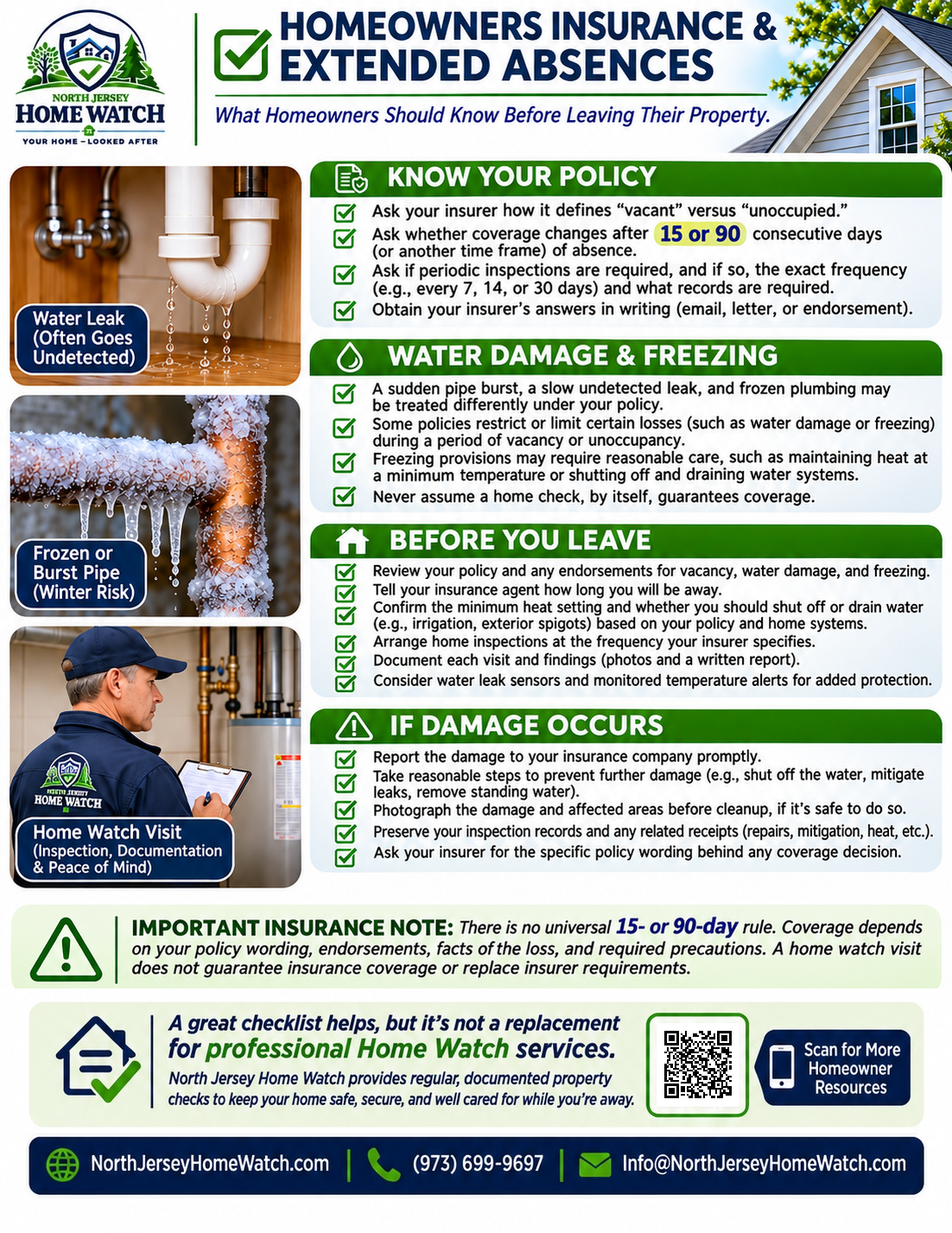
For many homeowners in New Jersey the allure of a winter in Florida or an extended summer abroad is part of the lifestyle. However, leaving a residence empty introduces complexities that go beyond simply locking the front door. We often see homeowners assume that their standard policy remains fully in effect regardless of how long the house stands empty. This is a dangerous misconception. Understanding HOMEOWNERS INSURANCE & EXTENDED ABSENCES What Homeowners Should Know Before Leaving Their Property is critical to ensuring your claim isn't denied when you need it most.
Insurance companies operate on the basis of risk management. A home that is lived in is a monitored environment. If a pipe leaks under the kitchen sink, a resident notices it within hours. If a window is smashed by a storm, it is boarded up immediately. In an empty home, that same leak can run for weeks, causing structural rot and mold that costs tens of thousands of dollars to remediate. Because the risk of catastrophic loss increases significantly when a property is left alone, insurers place strict limitations on coverage for unoccupied dwellings. In the following sections, we will break down the specific clauses and requirements every North Jersey homeowner needs to understand.
The Definition of Vacant versus Unoccupied
To the average person, 'vacant' and 'unoccupied' might sound like synonyms. To an insurance adjuster, they are worlds apart. An unoccupied home is one that still contains your furniture and personal belongings, with the intent that you will return. A vacant home is one that has been emptied of furniture and utilities, typically during a sale or a major renovation. Most standard policies allow for a home to be unoccupied for a short window, usually 30 or 60 days and in Canada it can be as short as 7 days. Once you cross that threshold, your coverage may be suspended or severely limited unless you have taken specific contractual steps.
When we talk about HOMEOWNERS INSURANCE & EXTENDED ABSENCES What Homeowners Should Know Before Leaving Their Property, we are focusing on the 'unoccupied' status. Even if your furniture is there, your policy likely contains a 'vacancy clause.' This clause stipulates that certain types of damage—specifically water damage, frozen pipes, and glass breakage—are not covered if the home has been empty for more than 30 consecutive days. For homeowners who travel for the season, this 30-day clock is the most important number in your policy documents.
The Frozen Pipe Clause in North Jersey
In our climate, frozen pipes are the single greatest threat to an empty home. New Jersey winters are notoriously unpredictable. A sudden polar vortex can drop temperatures into the single digits, and if your furnace fails while you are in the Caribbean, your home will reach freezing temperatures within 48 hours. Most insurance policies have a specific 'frozen pipe' exclusion. They will only cover the damage if you can prove you exercised 'due diligence' to maintain heat in the building or that you shut off the water supply and drained all systems and appliances.
Proving due diligence is difficult if no one was checking the property. If an adjuster sees that the heat was set to 55 degrees but a circuit breaker tripped two weeks prior, they may argue that you failed to provide adequate oversight. This is where documented visits become an insurance necessity rather than a luxury. By having a record of regular checks, you demonstrate to the insurer that you were actively mitigating risk.
Why Visual Inspections Matter for Coverage
Many homeowners believe that a high-tech smart home system is a sufficient substitute for a physical presence. While we love smart water shut-off valves and Wi-Fi thermostats, they are not foolproof. Batteries die, Wi-Fi routers crash, and sensors fail. More importantly, a smart sensor cannot detect a roof leak in the attic or a pest infestation in the basement. Most insurance carriers explicitly state that the homeowner must take reasonable steps to protect the property from further damage after a loss occurs.
If a storm damages your roof on day five of your vacation and you don't return for day sixty, the internal water damage that accumulated for 55 days may be excluded. The insurer will cover the initial roof damage but may deny the claim for the subsequent mold and interior rot because you didn't have a system in place to catch the issue early. Utilizing professional home watch services provides the physical eyes on the ground required to spot these issues before they escalate into 'deniable' claims.
HOMEOWNERS INSURANCE & EXTENDED ABSENCES What Homeowners Should Know Before Leaving Their Property and Vandalism
Empty homes are targets. Even in the safest neighborhoods with an overflowing mailbox, a driveway without tire tracks after a snowfall, or a pile of flyers at the front door signals that no one is home. Standard insurance policies often have a specific exclusion for vandalism and malicious mischief if the home has been unoccupied for the 30-to-60-day window. This means that if teenagers break in and spray-paint your walls or someone steals your copper piping, you could be left paying for the repairs out of pocket.
Maintaining the 'lived-in' look is a requirement for both security and insurance compliance. We recommend that our clients have their mail forwarded, their snow cleared immediately, and their interior lights set on varied timers. These actions don't just deter criminals; they provide a paper trail showing that the home was being actively managed during your absence.
The Role of an Unoccupied Home Rider
If you know you will be away for more than 30 days, your first call should be to your insurance agent. You may need to purchase an 'unoccupied home rider' or a separate 'vacant home policy.' These additions are designed to bridge the gap in coverage, but they often come with their own set of requirements. Many insurers will only grant these riders if the homeowner has a professional property management or home watch company checking the residence at least once a week.
When discussing HOMEOWNERS INSURANCE & EXTENDED ABSENCES What Homeowners Should Know Before Leaving Their Property with your agent, ask specifically about the frequency of inspections required. Some policies require a log of visits. We provide our clients with digital reports that include GPS-stamped photos and checklists through the Your-Home 360 platform which serve as verifiable proof for your insurance company that the property is being monitored according to their standards. This documentation is your strongest defense if you ever need to file a claim.
Pre-Departure Checklist for Insurance Compliance
Before you head out for an extended period, follow these steps to ensure you remain within the good graces of your insurance provider:
- Notify your insurance agent of the dates you will be gone and ask for any specific requirements regarding occupancy.
- Set your thermostat no lower than 55-60 degrees to prevent pipe freezes, and replace all thermostat batteries.
- Turn off the main water supply if your heating system doesn't rely on it (e.g., if you have a steam boiler, consult a professional first).
- Arrange for regular snow removal and landscaping to maintain the appearance of occupancy.
- Hire a professional like Robert with North Jersey Home Watch to conduct weekly or bi-weekly interior and exterior inspections.
- Keep a detailed log of all maintenance and home watch visits to present to an adjuster if needed.
Understanding HOMEOWNERS INSURANCE & EXTENDED ABSENCES What Homeowners Should Know Before Leaving Their Property is about being proactive. The worst time to find out about a 30-day vacancy clause is after a pipe has burst and the basement is flooded. In New Jersey, where homes can be older or even historic and repairs are costly, the stakes are simply too high to leave things to chance.
We specialize in providing the documented oversight that insurance companies look for. By bridging the gap between your departure and your return, we help ensure that your most valuable asset remains protected and your insurance policy remains valid. Don't let a well-deserved vacation turn into a financial nightmare because of a technicality in your policy's fine print.
If you are planning an extended trip and want to ensure your property meets the 'due diligence' standards of your insurance provider, we are here to help. I provide the detailed reporting and professional eyes needed to give you true peace of mind while you are away from North Jersey. Please schedule a consultation with me today to discuss a customized plan for your home.
Have more questions? View our full FAQ page
Questions, answered.
How long can I leave my home empty before insurance is affected?
Most standard New Jersey homeowners insurance policies include a vacancy or unoccupancy clause that kicks in after 30 to 60 days. Once this limit is reached, coverage for risks like water damage, glass breakage, and vandalism may be automatically suspended or restricted unless you have notified your insurer and potentially added an unoccupied home rider.
Will my smart home sensors satisfy insurance requirements for due diligence?
While smart sensors are helpful tools, they are rarely sufficient on their own for insurance purposes. Insurers typically look for 'reasonable care,' which often implies physical inspections to prevent secondary damage, such as mold growth after a leak. A documented log of physical visits from a home watch professional is much stronger evidence for a claim than a sensor report.
Do I need to turn off my water when I leave for the winter?
It depends on your heating system. If you have a dry heat system (forced air), turning off the main water and draining the pipes is a great way to meet the 'due diligence' requirement. However, if you have a boiler or hydronic system, your heat requires water to function. In these cases, regular physical checks are mandatory to ensure the heat stays on.